Cu-Diamond and Al-Diamond Composites: Smart Alternatives to Pure Diamond for Heat Sinks
The Composite Advantage
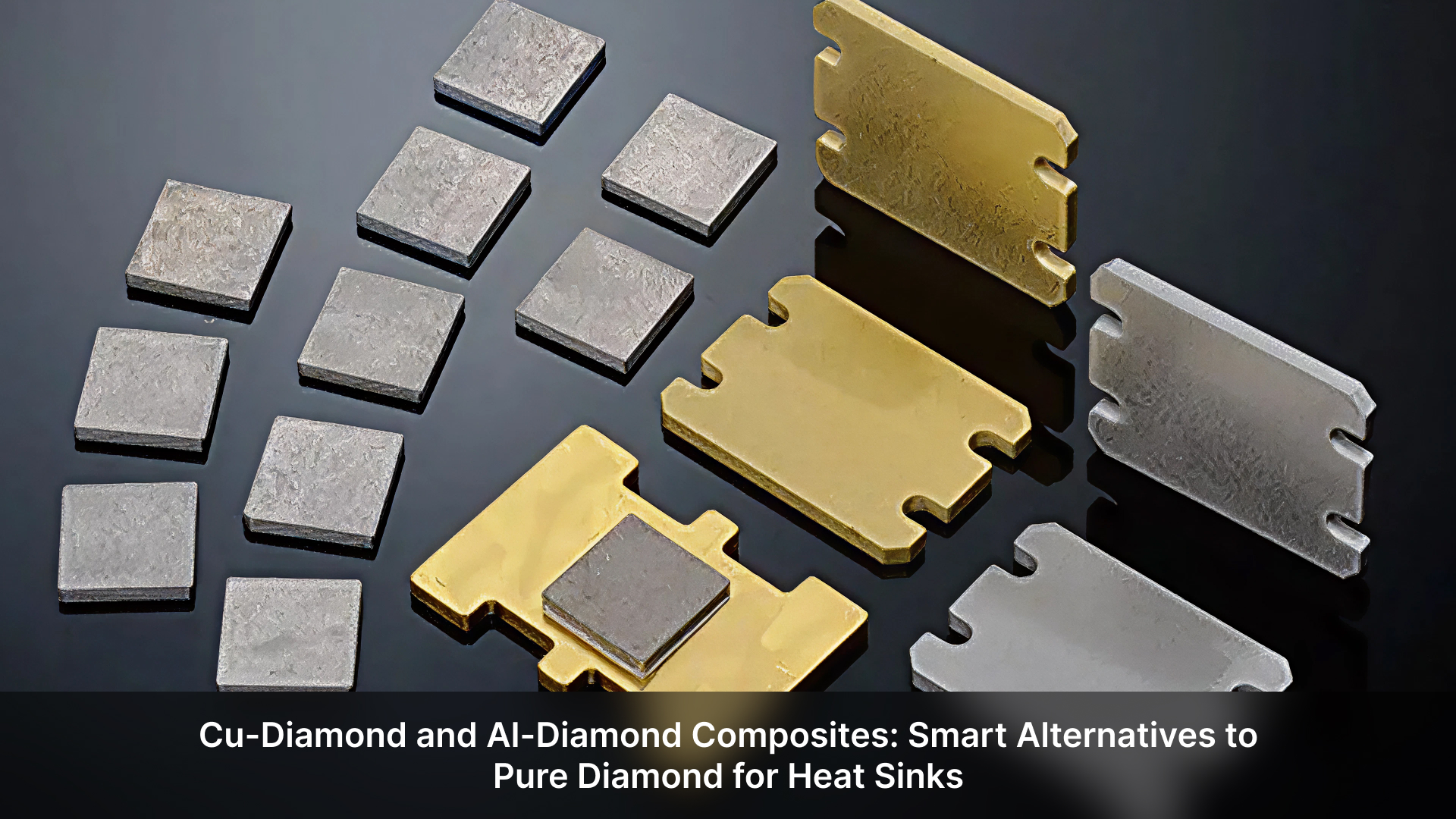
Metal-diamond composites combine the best characteristics of both constituents. Diamond particles provide exceptional thermal conductivity, while the metal matrix ensures manufacturability, machinability, and compatibility with conventional joining processes like soldering and brazing. The result is materials that approach diamond's thermal performance while retaining the cost-effectiveness and processing familiarity of traditional metals.
Cu-diamond composites achieve thermal conductivities of 600-1,200 W/mK up to 3x better than pure copper's 400 W/mK. Al-diamond composites reach 400-700 W/mK, offering 2-3x improvement over aluminum's 200-240 W/mK while maintaining low density crucial for weight-sensitive applications. These improvements enable smaller heat sinks, higher power densities, or improved reliability at equivalent sizes.
The economics are compelling. While pure diamond heat spreaders cost hundreds to thousands of dollars, equivalent Cu-diamond or Al-diamond components run $50-200 premium compared to pure metal but feasible for mid-range to high-end products. This pricing democratizes advanced thermal management, bringing solutions previously reserved for aerospace into commercial markets.
Copper-Diamond: High Performance Material
Copper-diamond composites target applications demanding maximum thermal performance without pure diamond's cost. With diamond volume fractions of 40-60%, these materials achieve thermal conductivities exceeding 1,000 W/mK in optimized formulations approaching pure diamond performance at roughly one-tenth the cost.
Manufacturing typically employs powder metallurgy: diamond particles mix with copper powder, then consolidate through sintering, hot pressing, or spark plasma sintering. The critical challenge is achieving good interfacial bonding between diamond and copper. Diamond's chemical inertness resists forming strong bonds with metals, and poor interfaces create thermal boundary resistance that negates the conductivity advantage.
Advanced processing uses carbide-forming interlayers thin coatings of titanium, chromium, or tungsten on diamond particles that react with both diamond and copper during processing, creating metallurgical bonds. Surface-treated diamonds with nanoscale metal coatings promote wetting and improve thermal conductance across interfaces. These interface engineering techniques are crucial differentiators between mediocre and exceptional composite performance.
Cu-diamond's thermal expansion coefficient (6-8 ppm/K) better matches silicon (2.6 ppm/K) than pure copper (17 ppm/K), reducing thermal stress in semiconductor packages. Density (5-7 g/cm³) is lower than pure copper (8.96 g/cm³), providing weight savings alongside thermal improvements valuable for aerospace and satellite applications where every gram matters.
Aluminum-Diamond: Lightweight Thermal Champion
Aluminum-diamond composites specifically address weight-sensitive applications where thermal performance and low density must coexist. Pure aluminum offers modest thermal conductivity but exceptional lightness at 2.7 g/cm³. Adding 50-60% diamond by volume boosts conductivity to 500-700 W/mK while maintaining density around 2.9-3.2 g/cm³.
This combination creates exceptional specific thermal conductivity conductivity per unit weight—that exceeds all conventional materials. For electric vehicle power electronics, where every kilogram affects range, Al-diamond heat sinks remove more heat per gram than any alternative. Aerospace applications, where launch costs scale with mass, benefit enormously from materials that don't compromise between thermal performance and weight.
Manufacturing Al-diamond presents unique challenges. Aluminum's reactivity with diamond at elevated temperatures can form aluminum carbide (Al₄C₃) a brittle, hygroscopic phase that degrades properties. Preventing carbide formation while achieving good bonding requires careful process control through gas pressure infiltration or squeeze casting under inert atmospheres. Protective coatings on diamond particles prevent direct aluminum-diamond contact, enabling processing while maintaining thermal performance.
Design Optimization and Performance Factors
Maximizing composite performance requires careful microstructural engineering. Diamond volume fraction directly correlates with conductivity higher diamond content generally improves performance. However, excessive diamond (above 65-70%) creates processing difficulties and can paradoxically degrade thermal performance by limiting metal phase connectivity.
Diamond particle size significantly impacts properties. Large particles (100-500 μm) provide long-range thermal paths but complicate processing. Small particles (10-50 μm) enable better surface finishes but exhibit higher interfacial resistance per unit volume. Multi-modal distributions combining large and small diamonds often yield optimal performance.
Interface thermal conductance often limits composite performance more than constituent properties. Even excellent interfaces exhibit thermal boundary resistance of 10-30 m²K/GW. With tens of thousands of diamond particles per cubic centimeter, cumulative interfacial resistance becomes substantial. This explains why composites with 50% diamond don't achieve 50% of the conductivity improvement toward pure diamond interfacial effects dominate.
Real-World Applications
Consumer electronics increasingly adopt metal-diamond composites. Flagship smartphones use Cu-diamond heat spreaders to improve thermal management in slim profiles, enabling sustained performance during gaming or computational photography. The improved heat spreading prevents throttling and enhances user experience.
LED lighting systems, particularly high-brightness automotive and industrial arrays, benefit from Al-diamond heat sinks. LED lifetime doubles with every 10°C junction temperature reduction. Al-diamond enables smaller, lighter fixtures maintaining optimal temperatures—improving performance and reliability while reducing costs compared to oversized aluminum solutions.
Electric vehicle power electronics represent a transformative market. Inverters and DC-DC converters must dissipate kilowatts while minimizing weight that reduces range. Al-diamond heat sinks enable 30-50% power density improvements versus pure aluminum, allowing smaller, lighter modules that improve vehicle efficiency. Automotive suppliers increasingly offer Al-diamond solutions as EV production scales.
Telecommunications base stations employ Cu-diamond heat spreaders in compact Massive MIMO installations with severe thermal constraints. Improved thermal performance enables higher output power from smaller amplifiers, directly improving network economics.
Aerospace and defense electronics leverage both Cu-diamond and Al-diamond extensively. Phased array radars, satellite transponders, and avionics all benefit from improved thermal performance at reduced weight. Defense budgets accept premium pricing for performance, making these early adopters that drive manufacturing maturity benefiting commercial applications.
Market Positioning and Future Outlook
Metal-diamond composites occupy strategic territory between conventional metals and exotic pure diamond. They serve applications requiring better-than-metal performance but unable to justify pure diamond costs a vast middle ground spanning consumer electronics to automotive to aerospace.
Manufacturing volume dramatically affects economics. High-volume production reduces cost premiums from 5-10x to 2-3x pure metal costs, making composites attractive for consumer applications. As electric vehicle production scales to tens of millions annually, Al-diamond approaches cost-competitiveness when system-level benefits are considered.
Technical advances continue improving performance. Interface engineering reducing boundary resistance by 30-50% could significantly boost thermal conductivity. Functionally graded composites with varying diamond concentration optimized for specific thermal profiles promise further improvements. Hybrid approaches combining metal-diamond composites with pure diamond inserts at critical hot spots might optimize cost-performance trade-offs.
Conclusion
Metal-diamond composites represent mature, practical thermal management solutions available today. They deliver 2-3x thermal conductivity improvements at costs one-tenth those of pure diamond, occupying a critical market position between conventional and exotic solutions. For engineers facing thermal challenges exceeding conventional material capabilities but lacking budgets for pure diamond, Cu-diamond and Al-diamond composites provide compelling answers.
These materials aren't experimental they're proven, commercially available solutions successfully deployed in production. Manufacturing costs continue declining, performance improves through interface advances, and applications expand from niche aerospace to mainstream consumer electronics. Metal-diamond composites aren't the future they're the smart choice today for advanced thermal management.